
AI Lead Follow-Up for Real Estate Agents: The System That Gets Replies (2026)

AI LEAD FOLLOW-UP
Yo, what up. I'm Adam Gillespie. My signature line is "the money is made in the follow up," and I have built a whole career on it because it is true. So let me be straight with you about the state of follow up in real estate. Most of it is dead on arrival. The lead comes in, an automated email that sounds like a robot from 2019 goes out, it lands in spam or gets ignored, and the agent tells everybody the leads are garbage. The leads are not garbage. The follow up is. This page is the system I teach to fix it: how AI lead follow up actually works, what the AI should touch, what it must never touch, and the guardrails that keep your license and your reputation safe while the machines do the heavy lifting.
THE SHORT VERSION
AI lead follow up works when it is a system, not a gadget. Every message you send has to survive three tests: get delivered, get opened, get replies. AI earns its keep in three places: answering new leads in minutes around the clock, rewriting your campaign language so it stops sounding like a robot, and keeping long term nurture alive without you babysitting it. The cadence of your campaign is the science and stays human designed. The words are the costume, and that is where AI shines. And one rule sits above everything: templates only. Live client conversations and client personal information never go into an AI tool, ever. That is a fiduciary and ethics line, not a tech preference.
Why do most real estate leads never get a real follow up?
Start with the crime scene, because I open my live teaching with it. Open your CRM right now and read the first two lines of your stock follow up email out loud. You know the one. "Just checking in to see if you are still interested in purchasing a home." Every agent in your market has that exact email sitting in their CRM, and your leads can smell it before they open it.
Then layer on the human problems. A new internet lead gets one call, maybe two, and then silence, because you got busy with the clients already in front of you. The lead who needed ninety days and eight touches to become a buyer gets two touches and a prayer. Multiply that by every lead you have ever paid for and you are looking at the most expensive habit in real estate. It is not a lead problem. It never was. It is a follow up system problem, and systems are fixable.
The ladder: delivered, opened, replies
Every follow up campaign you run has to climb three rungs, in order, and it dies if it falls off any one of them.
Rung one: get delivered. Spam trigger words and promotional language send your emails to Spam or the Promotions tab, and on texts the same language gets your number flagged by carrier filters. A perfect email in a spam folder is worth exactly zero.
Rung two: get opened. Opens are decided by the subject line, the preview text, and your name. Not the body. Nobody in history has opened an email because the third paragraph was amazing. If your subject lines are dead, your campaign is dead, no matter how good the writing under them is.
Rung three: get replies. This is where money actually happens, and it is where pressure language goes to die. "ACT NOW." "Limited time." "Don't miss out." Humans filter that stuff the same way the software does, instantly and without mercy. A follow up message has one job: start a conversation a human wants to continue. Watch replies, not just opens. Replies pay you. Opens just make your dashboard feel good.
What should AI actually do in your follow up?
Three jobs. AI is great at all three, and they are the difference between follow up that happens when you feel like it and follow up that happens every single time.
Job one: win the first five minutes. Every lead response study ever run lands in the same place. A lead touched in minutes converts circles around a lead touched in hours, and you cannot be awake and available twenty four hours a day. An AI sales agent can. In my world that is Lofty's AI Sales Agent, working new leads the second they land, nights, weekends, while you are at a closing. It starts the conversation at machine speed so a human can finish it at human speed. On teams, this pairs with routing, which I break down in my Lofty CRM for teams guide.
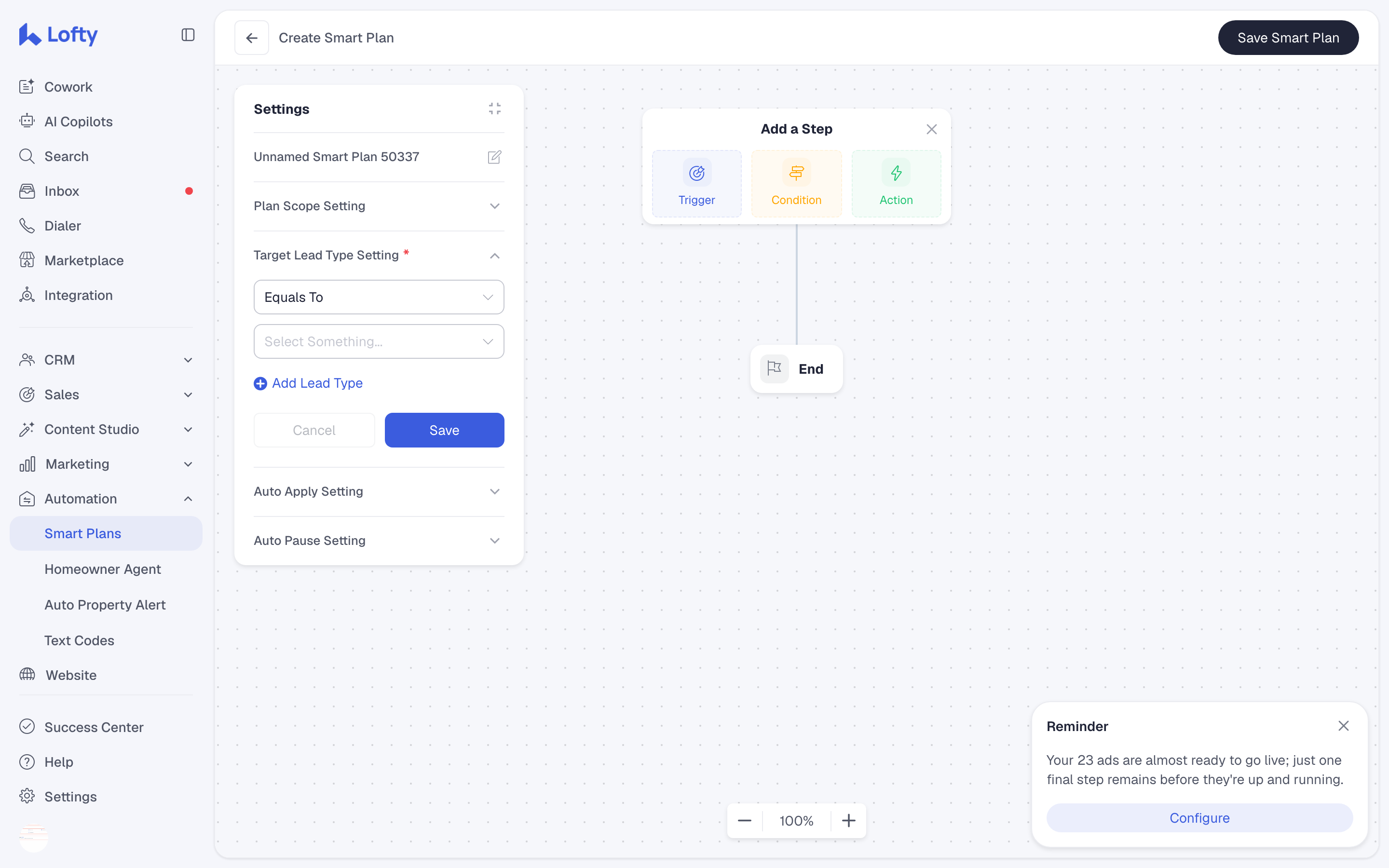
Job two: fix the language. This is the one I demo live, and it changes how people think about their whole CRM. Your campaign library is already written. It just sounds like a robot. I run stock campaigns through what I call a campaign rewriter prompt, and it does three things: it strips the spam triggers, hype, and pressure language that kill delivery and trust; it applies real copywriting, curiosity gap subject lines, open loops, plain words a human would actually say; and it protects your merge fields, your links, and your send timing, untouched. Here is the sentence to tattoo on your brain: you do not rewrite the plan, you rewrite the language. The timing of a Smart Plan is the science. The words are just the costume.
Job three: never let nurture die. Most of your database is not ready today, and that is fine, that is what nurture is for. AI keeps the long game alive, consistent touches over months, so the lead who buys in month seven buys from you and not from whoever emailed them in month six. Consistency is the whole game, and consistency is exactly what humans are worst at and machines are best at.
What does good AI follow up actually sound like?
Let me show you instead of telling you. This is a generic stock template, the kind sitting in a thousand CRMs right now. Subject line: "Following Up On Your Home Search." Body: "Hello, I am just checking in to see if you are still in the market to purchase a home at this time. Please do not hesitate to reach out. ACT NOW, homes are selling fast!"
Count the felonies. "Just checking in" says nothing. "At this time" is corporate filler. "Do not hesitate" is what a bank writes. "ACT NOW" is pressure language that trips filters and trust at the same time. Now the rewrite, same plan, same timing, new costume. Subject line: "Quick question about that home search." Body: "Hey, quick one. Are you still looking, or did life put the move on pause? Either way is totally fine, just tell me where your head is at and I will adjust. No pressure from me." Short. Plain. A question a person can actually answer, with an open loop and an easy out, which is exactly why people reply to it. That gap, between those two messages, is the entire ballgame.
The guardrails: where AI follow up is not allowed to go
This is the section nobody else teaches, and it is the reason this system is safe to run with a real estate license. Five guardrails, and the first one never gets cut, skipped, or negotiated.
One: templates only. Never paste a live client conversation into any AI tool. Never feed an AI your clients' personal information. Client PII inside an AI tool is a fiduciary problem and an NAR ethics problem, not a tech problem. We rewrite the library, never the client file. My line is drawn at ingestion. If the data never goes in, the data can never leak, get trained on, or end up somewhere your client never agreed to.
Two: protect the fields. Your merge fields, the little {{first_name}} pieces that personalize a plan, are load bearing. If a rewrite breaks one, the plan breaks, in front of a lead. Check every field before you save.
Three: words, not cadence. AI rewrites language. It does not get to reorder your plan, change your send timing, or invent new steps. The cadence was built on purpose. Hands off.
Four: test send to yourself. Every rewritten plan gets sent to your own phone before it goes live. Read it standing in your kitchen the way a lead would. If it sounds like a robot to you, it sounds like a robot to them.
Five: you are the sender of record. Your name is on every message your system sends. AI drafts, systems deliver, but it is your license and your brokerage on the line, so you read every word before it ever sends. Automation is how you get your time back. Abdication is how you lose your reputation. Know the difference.
Follow up mistakes AI will not save you from
Setting it and forgetting it. An AI campaign you never review is just a faster way to send the wrong thing for a year. Check replies weekly. Retire what nobody answers.
Letting AI close. AI starts conversations and keeps them warm. The moment a lead replies like a human, a human takes over. People buy houses from people.
Pasting client threads into a chatbot. Covered above, and worth repeating because it is the mistake with legal teeth. Templates only. Always.
No system underneath. AI follow up bolted onto a messy CRM is lipstick on chaos. The follow up layer sits on top of your pipelines, your plans, and your routing, which is the sequence I lay out in my Lofty CRM training guide and the Smart Plans guide.
Questions agents ask me about AI lead follow up
How fast should you respond to a new real estate lead?
In minutes, not hours. Every lead response study lands in the same place: the agent who answers while the lead is still looking at their phone wins the conversation, and the one who calls back two hours later is leaving a voicemail for somebody already talking to another agent. You cannot personally be that fast at 9 PM on a Sunday, which is exactly why the first touch belongs to an AI sales agent and the relationship belongs to you.
How many times should you follow up with a real estate lead?
Way more than twice. Most agents quit after one or two touches, and most buyers need consistent contact across weeks and months before they are ready. The exact number matters less than the system: an early burst while intent is hot, then steady nurture that never fully stops until the lead buys, lists, or tells you to stop. A written campaign plan, like a Lofty Smart Plan, is what makes that happen without willpower.
Can AI follow up with real estate leads for you?
Yes, for the parts machines are good at: instant first response around the clock, sending your campaign touches on schedule, and keeping long term nurture alive. AI should start conversations and keep them warm. When a lead replies and it becomes a real conversation about their money and their move, a human takes over. That split is the whole design.
Is it legal and safe to use AI for real estate follow up?
Using AI on your templates and campaigns is fine, and it is what I teach. The line is your clients' personal information and private conversations: those never get pasted or fed into an AI tool, because that is a fiduciary duty and NAR ethics problem, not a tech choice. You also stay responsible for every word sent under your name, so review and test send everything. Stay on the right side of those two rules and AI follow up is both safe and a massive advantage.
What is the best AI for real estate lead follow up?
The best setup is a system, not a single tool: an AI sales agent inside your CRM for instant response, a campaign engine like Lofty Smart Plans for the cadence, and an AI writing pass to fix the language so messages get delivered, opened, and answered. I run and teach that stack on Lofty, and the campaign rewriter prompt I demoed above lives in the Apex Prompt Library for members.
Go deeper: the Lofty Smart Plans guide covers the campaign layer in full, and the Lofty CRM training guide covers the system it all sits on.
Want the rewriter prompt and the full follow up library?
Inside Apex Elite AI you get the Prompt Library, including the campaign rewriter, the full Lofty follow up systems, both weekly calls, and a community building the same machine. Come build with us.
Join the Apex Elite AI Community
Want your follow up rebuilt with you, step by step? See how coaching works.
The money is made in the follow up, and automation is key to getting your time back. But the follow up only counts if it gets delivered, gets opened, and sounds like a human sent it.
Adam Gillespie, Apex Elite AI


